
EL FIN DE LA IMPUNIDAD
Las cumbres de ministros ya no son lo que eran
Vídeos, imágenes, sucesos y recortes de prensa
En Barcelona tuvo lugar la cumbre de ministros de cultura de los 27 países de la UE y su encuentro con el Foro de las Industrias Culturales.
La sociedad civil ha podido vigilar cuanto se estaba decidiendo sobre su futuro a través de la cumbre ciudadana paralela, (D’) Evolution Summit, creada para aportar propuestas concretas y demandas urgentes sobre derechos fundamentales en Internet y relatar en tiempo real lo que se estaba diciendo dentro del congreso oficial.
El (D’)EVOLUTION EN CIFRAS
Algunos datos que, veremos más adelante, son… “representativos”
:
Más de 5000 personas han podido conectarse a la retransmisión en directo y 700 redes sociales han trabajado espontáneamente para que las informaciones circulasen inmediatamente. Decenas de miles de blogs difunden (D’) Evolution…
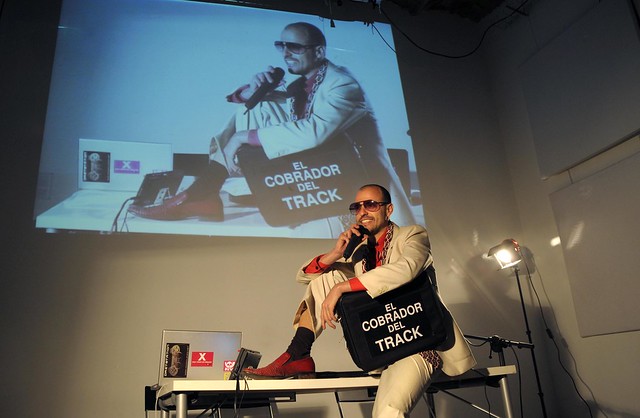
EL personaje del Cobrador del Track, un artista que intenta cobrar sus legítimos derechos de autor de obras en Creative Commons que las industrias culturales no le quieren pagar, tuvo en un sólo día más de 1000 fans.
La acción de (D’) Evolution junto con Leo Bassi titulada “No pagaremos el pato de una industria que no quiere reconvertirse” ha sido la imagen principal de todos los periódicos.
Cada día, media hora después de que acabarán las distintas sesiones del Congreso de las Industrias Culturales, emitíamos en directo los cortes con los momentos más destacados.
El corte en el que Eduard Punset interpela directamente a la Ministra española, Ángeles González Sinde, colgado en la red con el título de La Lección de Punset ha tenido 90.000 visitas en los dos primeros días, entrando en el ranking de los 5 vídeos más vistos de la red. Al día de hoy tiene ya 140 000 visitas.
CRÓNICA COMENTADA
Para comprender a que habían venido a Barcelona, aquí lo más destacado de la crónica comentada, difundida en tiempo (casi) real por el D’Evolution Summit, de lo que ministros e industrias han dicho:
1 – La lección de Eduard Punset a Sinde: No al control de Internet
1B – Comentario al discurso de Sinde: Basta ya de manipulación, ¿no? Más que con Patrimonio nos quedaremos en el mundo de Disney.
De como el intercambio de archivos está salvando patrimonio cultural más que cualquier industria recuperando material por su interés y no por su rentabilidad.
De como la cultura del acceso está creando empleo de calidad, más que la explotación de talento.
2 – Cultura = €conomía
“Nunca más cultura versus economía, a partir de ahora la cultura de la mano de la economía”. Mercedes Elvira del Palacio, subsecretaria del ministerio de Cultura de España. Si si, de cultura.
DIFÚNDELO. NO MÁS IMPUNIDAD
3 – Van Damme y la guerra de Internet
Guillermo Corral Van Damme, Director general de política e industrias culturales.
Cuando los políticos declaran guerra a sus representados les mandan a él.
4 – Más manipulación. Elvira del Palacio, subsegretaria del ministerio de Cultura de España.
No nos vendan más la historia del gratis total y paguen de una vez un salario justo a los artistas cuando trabajan por cuenta ajena.
5 – Otros Países – Ronda de ministros o similares:
1 – Federico Motta: “Sin copyright no puede existir ninguna expresión artística”.
No es de extrañar: viene de parte de la Confederación Italiana de las Industrias (sector cultura). Esta misma donde Berlusconi detiene a todas las televisiones y casi todos los medios de información y publicación. Claro, Internet, si no es de su propiedad, no interesa.
2 – Para el ministro de cultura alemán, copyright a ultranza, Internet: un peligro: “las oportunidad de la cultura están en las industrias culturales” y punto.
3 – Gabriela Canavilha, Ministra de cultura portuguesa: que maja! Es pianista de profesión. Ella lo sabe y lo deja claro: el problema no son los usuarios ni los creadores, son los intermediarios, quieren subsistir de algo por lo que ya no hacen falta. Una señora.
CONCLUSIONES
Pero se les ha torcido.
Hemos podido asistir en vivo y en directo como, cuando están vigilados, los gobernantes ya no pueden favorecer impunemente intereses particulares o llevar a cabo políticas de control simplistas con recetas ya obsoletas. Y, aunque lo intenten con alevosía y nocturnidad (la publicación en el BOE de la Ley de Economía Sostenible es también del día anterior a las vacaciones de Pascua), ya no les funciona:
1 – Los discursos para favorecer los lobbies de presión se les complican. Lo que hacen normalmente a puerta cerrada (y seguirán haciendo), cuando se hace público, cuando es discutido y contestado con argumentos, se les vuelve en contra.
Por esto:
a) Las grandes promesas de arrasar con todo lo que no está bajo su control a aquella parte de la industria multinacional que está monopolizando e impidiendo la circulación del conocimiento, han sido duramente contestada por la sociedad civil que ha respuesto en tiempo real, por sabios como Punset o Bauwens, por alguna parte de las propias industrias presentes que ya han optado por nuevos formatos y por varios responsables de cultura de los 27 países, no siempre participes de la simplista propaganda que se propina. Hemos visto que el discurso manipulador y agresivo de Sinde y sus guerreros Van Damme (Guillermo Corral) y Mercedes Elvira del Palacio con el que abrieron el Foro, en tan sólo 24h han derivado en discursos ambiguos y lamentosos, sin ninguna posible concreción.
b) La Comisión de Cultura y Educación de la UE decidió no aportar el Libro Verde de las Industrias Culturales durante la cumbre de Barcelona como anteriormente se había anunciado. Desde febrero saben que la cumbre iba a ser contestada sobre las temáticas del copyright y nos comunicaron que no iban a presentar las conclusiones para no “afectar equilibrios internos”. Sabemos, pues, que el discurso talibán está siendo puesto en discusión “internamente” y nos alegramos.
2 – Otro fenómeno interesante de ver es como, con la mirada perdida, sujetándose a un imaginario predigital dentro de un mundo que ya les ha superado en inteligencia y capacidad, dan bandazos con el tema de la representatividad.
Las personas que activamente están trabajando para defender sus derechos en entorno digital son actual y declaradamente, sólo en el estado español, como mínimo unas 300 000:
El Manifiesto En defensa de los derechos fundamentales en internet ha sido publicado y adoptado por más de 150.000 webs en castellano, y ha sido traducido en 10 idiomas.
La página de FaceBook que se le ha dedicado cuenta actualmente con más de 230.000 miembros.
RedSOStenible tiene la adhesión de 27.400 webs.
La Lista de Sinde, una lista de webs que se autodenuncian por enlazar, ha alcanzado las 1391 páginas…
Pero el guerrero Van Damme, un cargo escogido a dedo, defiende medidas antipopulares como la Ley Sinde diciendo que lo que la sociedad civil propone “no representa a nadie”.
Otro que utiliza este argumento es Andrés Dionis, nuevo director de la Coalición de Creadores, el lobby impulsor de la Ley Sinde. Andrés Dionis dice que estos 300 000 que protestan no representan a nadie porque no son un partido o una asociación. Esto es de lo más curioso cuando él representa una asociación que se llama “Coalición de Creadores” pero en la cual no hay ni a un solo creador. Ni siquiera Dios.
En el sistema político actual hay 2 cosas cruciales que hacen decantarse irremediablemente la balanza. A una de ella la sociedad civil no tiene acceso. Es el dinero. Pero a la otra sí. La otra justamente tiene que ver con la representatividad que ha cambiado de significado desde la democracia directa que permite Internet. Son los votos. Sólo se es representativos si alguien se siente representado.
Internet se representa solo, habla fuerte y claro. Cada una del las 300000 personas que protestan, no representan, simplemente son este movimiento masivo.
No se necesitan ya asociaciones verticales para que se nos oiga.
Delegar pasivamente se ha acabado, les guste o no. Los que son elegidos cada 4 años los elegimos para que trabajen al servicios del bien común. Internet tiene memoria y recordará quienes en estos días aprueben la ley Sinde sin el consenso de sus “representados”.
La ciudadanía ha pedido escucha. Ha aportado soluciones. El ministerio ha negado la escucha, ha ninguneado las soluciones.
A cambio la respuesta nos la han traído muy claramente el ninja Van Damme (Guillermo Corral): Esto es una guerra. “Tenemos que ganar la guerra de Internet”.
Los políticos declaran guerra a sus representados. Si quieren guerra, guerra será.
Una guerra sin sangre pero con en juego la devastación intelectual y económica del desarrollo digital, entregado en manos de dirigentes y emprendedores que defienden monopolios obsoletos y que no permiten que crezca nada más a su alrededor.
No hay duda que esta guerra la ganará la sociedad civil así como se pudo demostrar que la tierra era redonda o que las mujeres podían votar.
La cuestión es cuando y cuanto sufrimiento y oscurantismo conseguiremos evitar.
Como bien ha dicho nuestra ministra de cultura, “estamos viviendo momentos cruciales para el futuro de la humanidad”.
Ella ha podido escoger si pasar a la historia por ser la impulsora del esplendor de la era digital o como la Torquemada de XXI siglo.
Bien. Y nosotros seguimos.
Dos citas. La primera: les vemos en el Parlamento, en la discusión de la Ley de Economía Sostenible.
Y la otra, ineludible, en Granada, donde del 18 al 20 de abril de 2010 se reunirán los ministros de Telecomunicaciones y de Sociedad de la Información de la Unión Europea.
Ahí vamos a estar porque INTERNET NO SERÁ OTRA TV.
PRENSA Y GALERÍA DE IMÁGENES
Y ahora fotos y algo de prensa en papel (es que es la única que leen los ministros):
El País 1
El País 2
La Vanguardia 1
El País 3
Público 1
El País 4
Público 2
El País 5
20 Minutos 1
El Periódico 1
El Jueves
EuropaPress
RTVE
VilaWeb
El Periódico 2
El País 6
El País 7
ABC
Noticias.Com
20 Minutos 2
PortalTic
El País 8
Telecinco
ABC 2
20Minutos 3
El Mundo
El Mundo 2
Rebelión
20Minutos 4
Público 3
Diagonal
El País 9
Thetrendnet
Avui
El Mundo3
El Punt
La Gaceta Tecnológica
La Razón
La Vanguardia2
El Periódico3
El Punt2
[seo_thumb_gallery category="2010" gallery="Devolution" size="small"]
[seo_thumb_gallery category="Images" gallery="Devolution" size="small"]
Fotos tomadas por: Eloisa D’Orsi. Y también por Xose Quiroga y Héctor Julio Oca González.
NO A LA LEY SINDE
NO AL CIERRE DE WEBS
INTERNET TIENE MEMORIA
THE END OF IMPUNITY
Ministerial Summits are not what they used to be
Videos, images, events and press clippings
Barcelona hosted the summit of Ministers of Culture from the 27 European Union countries, and their meeting with the Forum of Cultural Industries.
The parallel citizen summit, the (D’) Evolution Summit – which was organized in order to put forward specific proposals and urgent demands on fundamental rights in Internet, and to give a real-time account of what was being said inside the official congress – allowed civil society to keep an eye on what was being said about its future.
Here are some details which, as we will see below, are… “representative”:
More than 5000 people were able to connect to the live internet broadcast, and 700 social networks worked spontaneously to ensure that the information circulated immediately.. Tens of thousands of blogs helped to spread (D’) Evolution…
The fictional character the Tracks Collector, an artist who tries to collect his legitimate royalties generated by works licensed under Creative Commons, which the cultural industries do not want to pay him, attracted more than 1000 fans in a single day.
The (D’) Evolution action with Leo Bassi titulada “No pagaremos el pato/We will Not Carry the Can for a cultural industry that does not want to reinvent itself was the lead image in all the papers.
Every day, half an hour after the end of each session at the Forum on Cultural Industries, we broadcast the edited highlights with live commentary. The edit showing Eduard Punset directly addressing the Spanish Minister, Ángeles González Sinde, which we posted online with the title La Lección de Punset/Punset’s Lesson had 90,000 visits in the first two days, making it one of the 5 most-watched videos on the net. It has now exceeded 150,000 visits.
To help us understand what they had come to Barcelona for, D’Evolution Summit had a day-by-day broadcast with commentary in (almost) real time of what the ministers and industries have said.
So for them, things didn’t go as planned.
We were able to verify, live, that when they are watched over, our rulers are not able to favour private interests with impunity, or to implement simplistic control policies based on obsolete formulas.
What we saw:
1 – The speeches supporting the interests of lobbies start to get a bit uncomfortable. What they usually do behind closed doors (and will continue to do). turns against them when it is discussed in public and has to contend with arguments.
This is why:
a) The grand speeches aimed at industry heavyweights, promising to get rid of anything that is not controlled by the multinational industry that is monopolizing and hindering the circulation of knowledge, have been strongly contested by civil society which responded in real time, by wise men like Punset and Bauwens, by a section of some industry participants in the forum who are already working on new formats and by a few of the cultural leaders from the 27 countries, who do not always share the simplistic propaganda they are dealt. We saw how in only 24 hours, the aggressive, manipulative speech with which Sinde and her warriors Van Damme (Guillermo Corral) and Mercedes Elvira del Palicio opened the Forum, turned into ambiguous and regretful speeches, in which nothing precise is said.
b) The EU Commission on Culture and Education decided not to present the Green Book on Cultural Industries during the meeting in Barcelona, as had been previously announced. Since February, they knew that the meeting would be contested on copyright issues, and we were informed that they would not present the conclusions in order to avoid “affecting internal equilibrium”. So we know that the taliban discourse is being discussed internally and we’re glad.
2 – Another phenomenon that was fascinating to watch is how, with an absent gaze, grasping at a pre-digital imaginary in a world that has already overtaken them in intelligence and capacity, they go around in circles discussing representativity. .
In Spain alone, right now, there are at least 300,000 people actively and openly working to defend their rights in the digital environment:
The Manifesto in Defense of Fundamental Rights on the Internet has been published and adopted by over 150,000 webs in Spanish, and translated into 10 languages.
Its page on FaceBook currently has more than 230,000 members.
RedSOStenible has the support of 27,400 web sites.
Sinde’s List, a list of web sites that self-report themselves for supposedly including illegal links, is now 1391 pages long.
But the warrior Van Damme, who was not voted into his position, defends unpopular laws like Sinde’s Law, saying that the proposals coming from civil society “don’t represent anybody”. Another person who uses this argument is Andrés Dionis, the new director of theCoalition of Creators, the lobby supporting the Sinde’s Law. Andrés Dionis says that these 300,000 people who are protesting don’t represent anybody because they are not a political party or association. This is specially odd when he himself represents an association called the “Coalition of Creators” which does not have a single creator as a member. Not even God.
In the current political system there are 2 key things that can irredeemably tip the balance one way or another. One of them, civil society has no access to: Money. But civil society does have access to the other thing. This second thing is precisely about “representatitvity”, which has changed its meaning since the Internet started to allow direct democracy: Votes. A thing is only representative if somebody feels represented by it. The Internet represents itself, it speaks loud and clear. Each and every one of the 300,000 people who protest do not represent, but simply are, this mass movement. There is no longer a need for vertical associations in order to make ourselves heard. Passive delegation is over, whether they like it or not. We elect people every four years so that they can work in the service of the common good. The Internet has a Memory and it will remember those who work against Internet without the consensus of those who they “represent”.
Citizens have asked to be heard, and put forward solutions. The Ministries have denied an audience, and ignored the solutions. But the answer has been brought to us loud and clear by the ninja Van Damme (Guillermo Corral): This is war. “We have to win the Internet war”.
Politicians declare war on their constituents. If they want war, they will get war. A war where there may be no blood, but what is at stake is the intellectual and economic devastation of digital development, handed over to directors and entrepreneurs who defend obsolete monopolies and don’t allow anything else to grow around it.
There is no doubt that this war will be won by civil society, just as the earth was eventually proven to be round and women ended up winning the vote. The question is when, and how much suffering and obscurantism we will be able to avoid.
As our Minister of Culture aptly put it, “we are living through times that are crucial to the future of humanity” THey have been able to choose whether to go down in history as a driving force behind the splendour of the digital era, or as the Torquemada of the 21st century.
Fine. And we continue.
Two upcoming dates on the calendar. The first: we’ll see them in the Spanish Parliament, in the discussion of the Law of Sustainable Economy.
And the other, essential appointment, in Granada, where the EU Ministers of Telecommunications and the Information Society will meet. We will be there, because THE INTERNET WILL NOT BE ANOTHER TV.
And now some photos and print news (which is the only news the ministers read).
El País 1
El País 2
La Vanguardia 1
El País 3
Público 1
El País 4
Público 2
El País 5
20 Minutos 1
El Periódico 1
El Jueves
EuropaPress
RTVE
VilaWeb
El Periódico 2
El País 6
El País 7
ABC
Noticias.Com
20 Minutos 2
PortalTic
El País 8
Telecinco
ABC 2
20Minutos 3
El Mundo
El Mundo 2
Rebelión
20Minutos 4
Público 3
Diagonal
El País 9
Thetrendnet
Avui
El Mundo3
El Punt
La Gaceta Tecnológica
La Razón
La Vanguardia2
El Periódico3
El Punt2
NO A LA LEY SINDE
NO AL CIERRE DE WEBS
INTERNET TIENE MEMORIA
Pictures by: Eloisa D’Orsi, Xose Quiroga and Héctor Julio Oca González.